I Switched to the Panasonic Hc X1200 and Here is What Happened
The landscape of professional videography has shifted dramatically over the last decade. While large-sensor mirrorless cameras have dominated the headlines, there is a persistent and growing demand for the traditional camcorder form factor, especially among event shooters, broadcast journalists, and independent documentary filmmakers. The transition from a DSLR-style workflow to a dedicated camcorder is often driven by a need for reliability, integrated audio, and extreme zoom ranges. Recently, many professionals have made the leap to the Panasonic HC-X1200, one of the most compact 4K 60p professional camcorders on the market. This shift represents more than just a change in hardware; it is a move toward a more streamlined, specialized way of capturing high-stakes motion imagery.
When a videographer decides to move away from a modular mirrorless setup in favor of the HC-X1200, they are typically looking to solve three major pain points: overheating during long clips, the lack of built-in physical controls, and the logistical nightmare of managing external audio recorders and lens transitions. The HC-X1200 promises to address these issues in a body that is surprisingly small, weighing in at just under three pounds with the battery and handle. For those who have switched, the experience is often one of immediate relief followed by a secondary learning curve regarding small-sensor physics and the nuances of Panasonic’s specific color science.
The Engineering Philosophy of the HC-X1200
At the heart of the Panasonic HC-X1200 is a 1/2.5-inch MOS sensor paired with the Venus Engine. To those coming from Full Frame or Super 35 backgrounds, a 1/2.5-inch sensor might seem diminutive. However, the engineering trade-off here is intentional. By utilizing a smaller sensor, Panasonic was able to integrate a Leica Dicomar lens with a 24x optical zoom range (25mm to 600mm equivalent). This is the primary reason many shooters switch. Achieving a 600mm reach on a Full Frame camera requires a lens that is often larger and heavier than the entire HC-X1200 body itself. This camcorder offers that range in a package that fits into a small shoulder bag.
The sensor is optimized for 4K video at up to 60 frames per second with 4:2:2 10-bit internal recording (at 30p) or 4:2:0 10-bit (at 60p). For broadcast and corporate work, these bitrates and color depths are critical. They allow for a reasonable amount of color grading in post-production without the image falling apart, although the HC-X1200 is designed to get the look "right" in-camera through its various scene files and gamma curves. The switch to this camera often signifies a preference for efficiency over the extreme shallow depth of field associated with larger sensors.
Real-World Performance: The Integrated Lens
One of the most immediate changes noticed after switching to the HC-X1200 is the behavior of the lens. The Leica Dicomar optics are remarkably sharp across the frame. Because the lens is permanently fixed and calibrated to the sensor, there is a level of edge-to-edge consistency that is hard to find in mid-range versatile zooms for mirrorless cameras. The five-axis Hybrid Optical Image Stabilization (O.I.S.) is another standout feature. When zoomed in at the 600mm equivalent, handheld shooting becomes surprisingly viable. The system uses a combination of optical and electronic stabilization to counteract the high-frequency vibrations that usually ruin long-telephoto shots.
Furthermore, the lens features three manual rings for focus, zoom, and iris. For a seasoned operator, this tactile interface is vastly superior to the fly-by-wire menus or single-ring designs of hybrid cameras. Being able to ride the iris while simultaneously adjusting focus during a live zoom is a hallmark of professional operation that the HC-X1200 facilitates effortlessly. This is particularly useful in environments like live theater or sports, where lighting conditions and subject distances change in a heartbeat.
Heat Management and Reliability
A significant reason for the professional migration to the HC-X1200 is "uptime." Mirrorless cameras are notorious for overheating when recording 4K 60p for extended periods, especially in warm climates or under stage lights. The HC-X1200 incorporates a new ultra-thin fan and a heat-dissipating design that pulls air through the back of the camera and exhausts it away from the sensor and processor. In real-world testing, this camera can run until the SD cards are full or the battery dies without ever showing a heat warning. For wedding videographers or those filming long-form conferences, this reliability is the difference between a successful contract and a catastrophic failure.
The camera features dual SD card slots, allowing for relay recording (automatically switching to the second card when the first is full) or simultaneous recording (creating an instant backup). The use of affordable, widely available SDXC UHS-II cards makes the switch economically feasible for many smaller production houses that don't want to invest in expensive proprietary media formats like CFexpress or P2 cards.
Detailed Feature Analysis
The HC-X1200 is packed with professional-grade input/output options that are often missing from "prosumer" gear. It includes two XLR audio inputs with phantom power, a full-size HDMI output, and built-in ND filters. The ND filter system is mechanical, offering choices of 1/4, 1/16, and 1/64 reduction. This allows the operator to maintain a specific shutter speed (usually 1/50 or 1/60 for a natural motion blur) even in bright midday sun, without having to screw on external filters.
Another "hidden" feature that users discover after switching is the built-in Wi-Fi and live streaming capability. The HC-X1200 supports RTSP/RTP/RTMP/RTMPS streaming, meaning you can stream directly to platforms like YouTube, Facebook, or Twitch without needing a computer or an external encoder. This has made it a favorite for house-of-worship installations and small-scale news organizations that need to get live footage onto the web instantly.
Discover deals on Cameras & Photography — updated daily.
View Offers →Autofocus and Tracking
Panasonic has historically used contrast-based autofocus, which has been a point of contention in the industry. However, in the HC-X1200, the implementation of "4K High-Precision AF" is specialized for the smaller sensor. It features face detection and a tracking system that is surprisingly sticky. Because the depth of field is naturally deeper on a 1/2.5-inch sensor, the AF system has a larger margin for error, resulting in fewer "hunts" or focused-on-the-background moments than one might expect. For solo operators who cannot always stay glued to the viewfinder, the face-tracking AF is a dependable tool.
Comparison of Specs: HC-X1200 vs. Industry Standard Hybrids
To understand why a professional would choose this over a standard mirrorless camera, one must look at the structural differences. While a hybrid might have a better sensor, the "system" of the HC-X1200 is often more complete for video tasks.
| Feature | Panasonic HC-X1200 | Typical 4K Hybrid Mirrorless |
|---|---|---|
| Optical Zoom | 24x (25mm - 600mm) | Requires Multiple Lenses |
| Cooling System | Active Internal Fan | Passive (Prone to Heat) |
| Audio Input | Dual XLR (Integrated) | 3.5mm Jack (Requires Adapters) |
| ND Filters | Built-in Mechanical | External Screw-on or Tray |
| Live Streaming | Direct via Wi-Fi/Ethernet | Requires External Capture Card |
| Battery Life | 4-5 Hours (High Capacity) | 1-2 Hours |
Insights into the User Experience
Moving to the HC-X1200 involves a change in how one perceives light. Because the sensor is smaller than those found in the GH series or the S series, its low-light performance is strictly average. In dimly lit reception halls or poorly lit auditoriums, digital noise becomes apparent earlier than it would on a larger sensor. Operators who switch to this camera quickly learn that proper lighting is not just a stylistic choice but a technical necessity. To mitigate this, the camera includes a built-in LED video light on the top handle, which is surprisingly bright and capable of filling in shadows for close-up interviews.
The ergonomics are another major shift. The top handle is removable, but most professionals keep it attached for the XLR inputs and the physical zoom rocker. The rocker allows for incredibly slow, smooth "creep zooms" that are almost impossible to replicate with a manual lens on a mirrorless camera. This adds a level of polish to corporate videos and documentaries that signifies high production value.
Pros and Cons of the Panasonic HC-X1200
Every tool has its limitations, and the HC-X1200 is no exception. Understanding these balance points is essential for any buyer considering the switch.
- Pro: Extreme Portability. It is one of the smallest camcorders to offer 4K 60p and XLR inputs, making it ideal for travel and run-and-gun shooting.
- Pro: Integrated Professional Audio. Use of high-end shotgun and lavalier mics without messy cables or external recorders.
- Pro: Massive Zoom Range. From wide-angle establishers to tight close-ups of distant subjects without changing lenses.
- Pro: No Overheating. Reliable long-form recording in any environment.
- Pro: Built-in ND Filters. Rapid adaptation to changing outdoor light.
- Con: Small Sensor Limitations. More noise in low light compared to APS-C or Full Frame rivals.
- Con: Deep Depth of Field. Harder to achieve the "blurry background" cinematic look without significant subject-to-background distance.
- Con: Menu Complexity. The professional menu system is deep and can be intimidating for newcomers.
- Con: Small EVF and LCD. While functional, the screens are smaller than those on some modern mirrorless cameras, making critical focus slightly tougher without peaking.
Buying Guide: Is the HC-X1200 Right for You?
The decision to buy or switch to the Panasonic HC-X1200 should be based on your specific workflow. It is not a "cinematic" camera in the sense of a Hollywood film; rather, it is a "workhorse" camera. If you find yourself frequently shooting events where you cannot control the distance to the subject—such as graduations, sports, or press conferences—the 24x zoom is a game-changer. The ability to sit at the back of a large room and still get a frame-filling headshot of a speaker is the HC-X1200’s greatest strength.
Buyers should also consider their output requirements. If your work is primarily for social media where the "bokeh" look is king, you might find the 1/2.5-inch sensor frustrating. However, if your work is destined for broadcast, YouTube tutorials, or corporate archives where clarity, stability, and audio quality are more important than artistic blur, this camera excels. Furthermore, if you are a solo operator who needs to stream live, the HC-X1200 is one of the most cost-effective all-in-one solutions available.
When purchasing, it is wise to invest in the larger VW-VBD58 battery packs. While the camera is efficient, these higher-capacity batteries provide nearly a full day of shooting, further enhancing the "worry-free" nature of the camcorder. You should also ensure you have V30 or V60 rated SD cards to handle the high bitrates of 10-bit 4K recording.
Who Should Make the Switch?
Educational Institutions: The HC-X1200 is robust and all-in-one, making it a perfect tool for students to learn the fundamentals of broadcast operation without the complexity of managing a lens kit.
Freelance Journalists: The ability to record, edit, and stream from a single device that fits in a backpack is invaluable for breaking news.
Discover deals on Cameras & Photography — updated daily.
View Offers →Event Videographers: Foregoing the need for a gimbal and external audio recorders allows for a much faster setup and breakdown time at weddings or parties.
Advanced Techniques for the HC-X1200
For those who have already made the switch, getting the most out of the HC-X1200 requires diving into the "Scene File" settings. Panasonic provides a range of adjustable parameters including Master Detail, Skin Tone Detail, and various Gamma modes. Setting the camera to "CINE-LIKE V" or "CINE-LIKE D" can help squeeze a bit more dynamic range out of the small sensor, providing a more pleasant roll-off in the highlights. Users also recommend mapping the user buttons to functions like "Focus Assist" and "One-Push AF" to speed up the operation in the field.
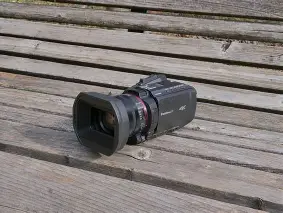
Another tip for new users is to leverage the "i.Zoom" feature. In 4K, this extends the 24x optical zoom to 32x (or 48x in 1080p) using intelligent interpolation that is virtually indistinguishable from optical zoom. This effectively turns the camera into a long-range scouting tool, allowing you to capture details from immense distances that would be impossible with almost any other portable camera system.
The Impact of 10-Bit Color
While much of the marketing for the HC-X1200 focuses on its size and zoom, the inclusion of 10-bit internal recording is perhaps its most significant "pro" feature. In 8-bit video, colors are represented by 256 levels per channel. In 10-bit, that jumps to 1,024 levels. For a small-sensor camera, this is a lifeline. It means that when you are filming a clear blue sky or a softly lit wall, you won't see the "banding" or blocky artifacts that often plague small cameras. It allows the Venus Engine to capture subtle gradations in skin tones, making the final image look much more professional and "expensive" than its physical footprint would suggest.
The Evolution of the Camcorder
The switch to the HC-X1200 highlights a broader trend: the specialization of gear. For a few years, the "do-it-all" mirrorless camera was the goal for every videographer. But as the industry has matured, professionals are realizing that "doing it all" often means "doing it with more effort." The HC-X1200 doesn't try to be a still camera. It doesn't try to have the largest sensor. It tries to be the most efficient 4K video capture device for a person working alone.
This camera represents the peak of the small-sensor camcorder evolution. It takes the lessons learned from decades of ENG (Electronic News Gathering) camera design and shrinks them down into a body that doesn't require a shoulder mount or a heavy-duty tripod. For the modern creator, this means more freedom, fewer technical hurdles, and a more reliable path from the "Rec" button to the final render.
Final Thoughts on the Transition
Switching to the Panasonic HC-X1200 is often a move toward pragmatic professionalism. It is an acknowledgement that while large sensors and interchangeable lenses are wonderful for narrative cinema, they can be a hindrance in the fast-paced world of live events and news. The HC-X1200 provides a sense of security. You know the audio will be clean because of the XLRs. You know you won't miss the shot because the 24x zoom covers everything. You know the camera won't shut down in the middle of a speech because of the internal fan.
What happened when people switched? They found they spent less time worrying about their gear and more time watching their subjects. They found their equipment bags got lighter and their setup times got shorter. While they may have sacrificed the ultra-shallow depth of field of their previous rigs, they gained a level of versatility and reliability that is arguably more valuable in the professional marketplace. The Panasonic HC-X1200 is a testament to the idea that the best camera is the one that gets out of your way and lets you do your job.